

10 Key Checkpoints for Creating a Rock Garden on a Golf Course 골프코스에 락 가든 조성시 체크항목 10가지
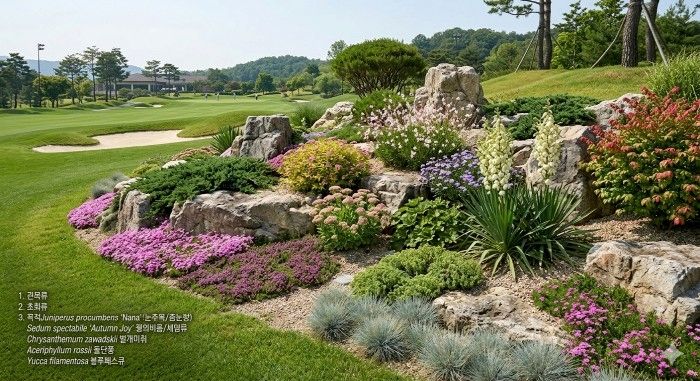
Rock gardens are ideally located in non-playable, out-of-play zones to avoid disrupting the game.
10 Key Checkpoints for Creating a Rock Garden on a Golf Course
골프코스에 락 가든 조성시 체크항목 10가지
When creating a Rock Garden within a golf course, it is essential to consider not only its aesthetic appeal but also player safety, pace of play, and long-term maintenance efficiency. A well-designed rock garden should complement the golf course while minimizing operational challenges.
The following are the 10 essential checkpoints for successfully designing and constructing a golf course rock garden.
1. Ensure Player Safety (Protection from Mishit Shots)
Checkpoint: Are the angle and placement of the rocks safe for golfers?
Details: If rocks are installed near tee boxes or landing areas (IP: Intended Landing Point), mishit balls may strike the rocks and ricochet back toward players. To prevent dangerous rebounds, rocks should be partially embedded into the slope or positioned so that their faces are angled away from the primary direction of play.
2. Avoid Interference with Pace of Play
Checkpoint: Is there a high probability that golf balls will become lost between rocks or dense plantings?
Details: When a rock garden is located too close to the rough or green, golf balls can become trapped in crevices, resulting in lost balls and slower play. Rock spacing should allow balls to remain visible, or the gaps should be filled with decorative gravel (such as egg stone) to prevent balls from becoming lodged.
3. Provide Adequate Access for Maintenance Equipment
Checkpoint: Can ride-on mowers and other maintenance equipment safely access and maneuver around the rock garden?
Details: Narrow spaces around rocks require labor-intensive trimming with string trimmers instead of mechanical mowing, significantly increasing maintenance costs. Sufficient clearance should be provided for maintenance vehicles and equipment.
4. Design an Effective Drainage System
Checkpoint: Will the rock garden remain stable during heavy rainfall without causing runoff onto the fairway?
Details: Since rock gardens are often built on slopes, proper drainage ****sys****tems—including interceptor drains, U-shaped channels, or French drains—should be installed to manage stormwater. Poor drainage can promote moss growth on rocks and cause plant root diseases.
5. Maximize the Use of Existing Natural Stone
Checkpoint: Can natural rocks excavated during course construction be utilized?
Details: Reusing on-site boulders and natural stone is far more economical than importing landscape rocks. It also ****create****s a more natural appearance and better visual harmony with the surrounding golf course.
6. Select Plants Suitable for the Local Climate
Checkpoint: Are the ****select****ed plants capable of withstanding intense sunlight, drought, and strong winds?
Details: Rocks absorb and radiate heat, creating dry growing conditions. Drought-tolerant perennials such as Sedum, Mukdenia (Aceriphyllum), junipers, dwarf conifers, and ornamental grasses perform well in these harsh environments.
7. Prepare Proper Soil Composition and Planting Depth
Checkpoint: Is the planting soil designed to resist erosion while providing adequate drainage and moisture retention?
Details: Using only decomposed granite or sandy soil can result in poor drainage or soil erosion. A balanced mixture of decomposed granite, peat moss, and perlite (or coarse gravel) should be used to ****create**** a stable growing medium with sufficient rooting depth.
8. Plan for Weed Control and Mulching
Checkpoint: Have weed barriers and gravel mulch been incorporated into the design?
Details: Weed management is critical in golf course maintenance. Landscape fabric should be installed between rocks, followed by a thick layer of decorative gravel or lava rock to suppress weed germination and reduce future maintenance requirements.
9. Maintain Harmony with the Overall Golf Course Design
Checkpoint: Does the rock garden complement the golf course''''s architectural style and overall scale?
Details: Small residential-style rock gardens often appear out of place in expansive golf course settings. Instead, bold compositions featuring large specimen boulders should be used to ****create**** a natural, visually powerful landscape that matches the scale of the course.
10. Ensure Long-Term Maintenance Efficiency
Checkpoint: Have irrigation conflicts and winter freeze protection been addressed?
Details: Fairway sprinkler heads should not spray directly onto the rock garden, as excessive water can erode soil and damage plants. A dedicated drip irrigation ****sys****tem is recommended. In regions subject to freezing temperatures, rocks should be securely anchored to prevent movement caused by frost heave or freeze-thaw cycles.
Conclusion
A successful golf course rock garden should achieve a balance between landscape aesthetics, golfer safety, playability, environmental sustainability, and maintenance efficiency. Careful planning and engineering at the design stage will ensure that the rock garden enhances both the beauty and functionality of the golf course for many years.
Source:This material was prepared based on lecture notes from the Pro Green Keeper Program at Konkuk University. The program provides one year of professional education in golf course turfgrass management, arboriculture, and golf course construction and maintenance, while preparing students for the Level 1, Level 2, and Level 3 Greenkeeper Certification.
Contact: +82-2-453-3786
Website: www.kkugk.com
※ Disclaimer: This article has been generated using AI (Artificial Intelligence) automated translation technology and may contain partial mistranslations or unnatural grammatical expressions. Therefore, please use this translated version solely as a reference to help understand the context of the original content.