
ESG (Environment · Social · Governance) is Transforming Golf Courses (영어) -ESG가 골프장을 바꾼다
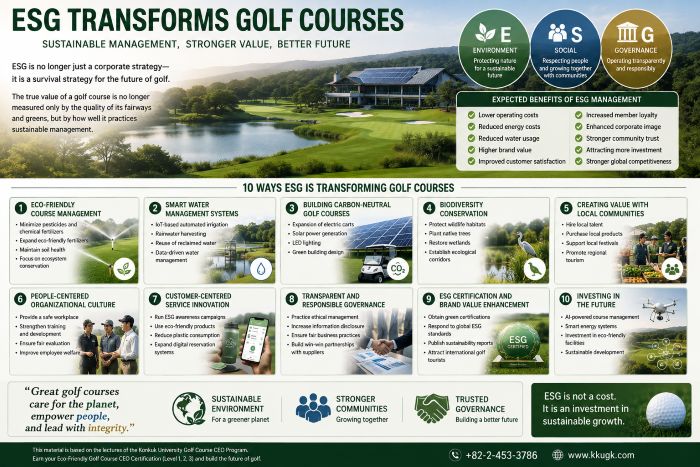
10 Ways ESG is Transforming Golf Courses
[ ESG (Environment · Social · Governance) is Transforming Golf Courses (영어) ]-ESG가 골프장을 바꾼다
In the past, a golf course''s competitiveness was largely determined by the beauty of its course, the quality of its facilities, and the level of customer service.
Today, however, ESG (Environment · Social · Governance) management has become a key factor in determining the competitiveness and long-term sustainability of golf courses.
As climate change accelerates, environmental regulations become stricter, and eco-conscious consumer behavior continues to grow, golfers are no longer looking only for beautiful courses. They increasingly prefer golf clubs that protect the environment, contribute to local communities, and operate with transparency and integrity.
ESG is no longer merely a corporate management strategy—it has become a survival strategy for the golf courses of the future.
The prestigious golf course of tomorrow will not simply be one with outstanding fairways and greens. Instead, it will be one that protects the environment (Environment), respects people and local communities (Social), and operates with transparency and accountability (Governance).
Today, the value of a golf course is no longer judged solely by the quality of its fairways and greens. The extent to which it embraces sustainable management will determine its future brand value and competitive advantage.
★ 10 Ways ESG is Transforming Golf Courses
1. Eco-Friendly Course Management
Minimize the use of pesticides and chemical fertilizers
Expand the use of environmentally friendly fertilizers
Maintain healthy soil conditions
Focus on eco**sys**tem conservation
Modern golf course management is no longer limited to maintaining high-quality turf; it also encompasses the protection and preservation of the natural environment.
2. Smart Water Management Systems
IoT-based automated irrigation
Rainwater harvesting and recycling
Reuse of reclaimed water
Data-driven water consumption management
In the era of climate change, efficient water conservation has become one of the greatest competitive advantages for golf courses.
3. Building Carbon-Neutral Golf Courses
Expansion of electric golf carts
Installation of solar power **sys**tems
Adoption of LED lighting
Environmentally sustainable buildings
Reducing carbon emissions throughout golf course operations is a fundamental objective of ESG management.
4. Biodiversity Conservation
Protect wildlife habitats
Plant native tree species
Restore wetlands
Establish ecological corridors
Golf courses have the potential to become expansive ecological parks where nature and recreation coexist in harmony.
5. Creating Shared Value with Local Communities
Hire local talent
Purchase locally produced agricultural products
Support local festivals and events
Promote regional golf tourism
Golf courses can serve as important platforms for regional economic development.
6. Building a People-Centered Organizational Culture
Provide a safe working environment
Strengthen employee education and training
Ensure fair performance evaluations
Improve employee welfare and benefits
Employee satisfaction ultimately leads to higher customer satisfaction.
7. Customer-Centered Service Innovation
Operate ESG awareness campaigns
Use environmentally friendly products
Reduce plastic consumption
Expand digital reservation **sys**tems
Golfers themselves become active participants in ESG practices.
8. Transparent and Responsible Governance
Practice ethical management
Increase information disclosure
Ensure fair business practices
Build win-win partnerships with suppliers
Transparent governance builds trust and strengthens long-term competitiveness.
9. ESG Certification and Enhanced Brand Value
Obtain environmental certifications
Respond to international ESG evaluation standards
Publish sustainability reports
Attract international golf tourists
ESG has become a new source of brand value and competitive differentiation for golf courses.
10. Investing in the Future
AI-powered course management
Smart energy **sys**tems
Investment in environmentally friendly facilities
Sustainable development initiatives
Investment in ESG is not an expense—it is an investment in long-term profitability and future growth.
Note: This material is based on the lecture content of the Konkuk University Golf Course CEO (Chief Executive Officer) Program. The program provides one year of education covering golf course management technology and the responsibilities of the five major operational departments of a golf course. Participants may also earn the Eco-Friendly Golf Course CEO Certification (Levels 1, 2, and 3).
Contact: +82-2-453-3786
Website: www.kkugk.com
※ Disclaimer: This article has been generated using AI (Artificial Intelligence) automated translation technology and may contain partial mistranslations or unnatural grammatical expressions. Therefore, please use this translated version solely as a reference to help understand the context of the original content.